 Cool is cool, and it can't be defined, refined, faked, imitated, put on, made up, manufactured, passed on, passed out, taught, illustrated, or theorized. Willy DeVille was cool, epitomized cool, the coolest of cats, a high priest of cool, a doctor of cool, a professor of cool, Mr. Cool, Master Cool Daddy, and he could dance a little too. Angelic and tough, dapper and disdainful, feminine and manly, soul boy and rocking man, he carved out a niche that was totally his own in the infamous hazy daze of CBGB's burgeoning and all-over-the-map prehensile punk scene with his exquisitely monikered band, Mink DeVille. Willy (born William Boray), skinnier than a menthol cigarette, resplendent in luxuriant pastels, skyscraper hair, mondo boots pumping time, suitjacket slung over the shoulder in pure Sinatra style, a suave bantam weight with pure New York vibes emanating out of every pore, lithe and leonine, he trotted out his very own personal version of the blended up blues-vocal group-r&B-4/4 rock and roll with only an attitude that might be classified as punk. DeVille commanded the stage as he switched up from guitar-slinger to harp-blower to rock brayer to spotlight crooner, a performer drenched in cool, vibrating cool, hand-delivering cool.(One look at William turned Willy and you just knew he was an all-time slow dancer, as long as his partner didn't mind the switchblade in his pocket pressing against her.) Quick think yer very own checklist of rock and roll cool (electric Dylan, purple Prince, exiled Keith Richards, junked-up Johnny Thunders, twenty flight Eddie Cochran) and know (especially those smart, lucky, or privileged to have caught the man live), that Willy Boy was on the top of that chart, a significant factor in the overall annals of rock and roll. Willy may be heading where angels fear to tread, strutting the Cadillac walk or doing up the Spanish stroll, eternally hunting for his Venus of Avenue D, but no doubt about it, he's bringing The Cool.
Friday, August 7, 2009
One of a Kind: RIP Willy DeVille 1953-2009
Cool is cool, and it can't be defined, refined, faked, imitated, put on, made up, manufactured, passed on, passed out, taught, illustrated, or theorized. Willy DeVille was cool, epitomized cool, the coolest of cats, a high priest of cool, a doctor of cool, a professor of cool, Mr. Cool, Master Cool Daddy, and he could dance a little too. Angelic and tough, dapper and disdainful, feminine and manly, soul boy and rocking man, he carved out a niche that was totally his own in the infamous hazy daze of CBGB's burgeoning and all-over-the-map prehensile punk scene with his exquisitely monikered band, Mink DeVille. Willy (born William Boray), skinnier than a menthol cigarette, resplendent in luxuriant pastels, skyscraper hair, mondo boots pumping time, suitjacket slung over the shoulder in pure Sinatra style, a suave bantam weight with pure New York vibes emanating out of every pore, lithe and leonine, he trotted out his very own personal version of the blended up blues-vocal group-r&B-4/4 rock and roll with only an attitude that might be classified as punk. DeVille commanded the stage as he switched up from guitar-slinger to harp-blower to rock brayer to spotlight crooner, a performer drenched in cool, vibrating cool, hand-delivering cool.(One look at William turned Willy and you just knew he was an all-time slow dancer, as long as his partner didn't mind the switchblade in his pocket pressing against her.) Quick think yer very own checklist of rock and roll cool (electric Dylan, purple Prince, exiled Keith Richards, junked-up Johnny Thunders, twenty flight Eddie Cochran) and know (especially those smart, lucky, or privileged to have caught the man live), that Willy Boy was on the top of that chart, a significant factor in the overall annals of rock and roll. Willy may be heading where angels fear to tread, strutting the Cadillac walk or doing up the Spanish stroll, eternally hunting for his Venus of Avenue D, but no doubt about it, he's bringing The Cool.

Monday, August 3, 2009
SHELF LIFE # 1

(As monomaniacal as I might truly be, maintaining a blog of this high degree of purity and insight (heh-heh) gets wearying. I realize I have enough know-it-all-pallies, informormed buds, and sharp hipster connections, that I oughtta let one or two of you bring it on home occasionally. Here’s the basic premise: 1-3 concise paragraphs about a CD (or as we old schoolers still refer to it-an album) that wasn’t necessarily an all-timer, a Blonde on Blonde or a London Calling. Instead, spotlight a possible peripheral release that stands the test of time and delivers on its small promises, or simply executes succinctly and manages to remain on yer personal playlist--- a sideways record, an overlooked effort, a self-contained minor gem, ya know, a record that’s got Shelf Life. Send me your brilliant overview in simple word form, and I’ll post ‘em up, giving my avid and obsessive readers (heh-heh-heh) an occasional breather from the sound of one man pontificating.)
Sylvain Sylvain (RCA), 1979
Anyone who got a chance to catch the last New York Dolls tour had to sit up and take note of forever sparkplug Sly Sylvain, whose spirited presence and pure authenticity helped buoy every performance. Slyvain has long been the most underrated of Dolls, and even I, a long gone worshipper at the junkie alter of Johnny Thunders have often been guilty of giving good ol’ Syl short shrift. The truth is, Sylvain’s first release, the self titled Sylvain Sylvian, actually stands right next to the much vaunted and much more visible first post-Doll releases of his colleagues David Johansen and Thunders. I remember listening to it upon its release and immediately latching on to its simple but catchy tone and undeniable listenability—I just couldn’t (at the time) figure where it landed on the all important youthful Cool Measurement Scale. It just seemed, well, so un-Doll-like, and, yep, un-punk-like, it became a closet listening experience for me when I used to value style and choice over substance and attainment.
Syl’s assembled band includes three members of his Mr. David Jo Doll’s first band, bassist Buz Verno, guitarist Johnny Rao, and keyboardist Bobby Blain, alongside drummer Lee Crystal (Joan Jett) and sax man Jonathan Gerber. Syl, once again an often overlooked songwriter as a Doll, obviously brought a certain esprit to Thunders Keith Richards-gone-punk riff rock and David Jo’s ironic NYC twisting of the Chicago blues. His first solo effort is essentially a straightforward and heartfelt paean to Dion, the Brill Building, and the sweet sounds of 60’s girl groups, with a nod to The Rascals. Best of all, it is all delivered with an unabashed sincerity and unaffected straightforwardness, equally high-spirited and coolly retro, all of it done with a craftsman’s touch.
“Teenage News” the opener, is a bright dash and bash of pure pop, while the album’s most memorable song, “What’s That Got to do With Rock’n’Roll” is an ersatz Rock-Is-It declarative number that the likes of Dave Edmunds, Nick Lowe, or Brian Seltzer would kill to have written. “I’m So Sorry” could have (and should have) been a combative siren song belted out by Ronnie Spector or Nancy Sinatra, and boy, and it’s hard to believe that some sorta hipster filmmaker hasn’t grabbed it for a soundtrack by this point. “Without You” and “Every Boy and Every Girl” are sweetened nuggets written in the same vein (piano driven, do-wah-diddy background vocals, unblushing lovesick pop tales) while “14th Street Beat” is pure retro, but also pure New York, in a thoroughly unaffected way. “Deeper and Deeper” should have been delivered by Willie DeviIlle, another 60’s pop torch song woven with slightly updated stylistics. “Ain’t Got No Home is a decent take on the venerable Clarence Henry classic, nothing ventured, nothing gained, while “Tonight" is a saxophone-filled coda, a neat instrumental finale to a truly neat recorded offering. Tip of the hat to Egyptian-born Syl Mirhazi, epitomizer of one piece of the ever pounding New York sound puzzle, able precursor to the future punk rock sweepstakes, possessor of rock and roll true blood, with a debut solo you almost haveta dance to.
Wednesday, July 29, 2009
Rickey Fly Right

I was extremely pleased that Jim Ed Rice finally made it to the Hall of Fame, but I took particular pleasure in also seeing Rickey Henderson, a true one-of-a-kind ballplayer, making it unarguably to the hallowed Hall. Anyone who has followed baseball closely knows that Rickey was also a one-of-a-kind character, and the hope was he would deliver a left field induction speech, but, alas it didn’t happen. Somehow Rickey flew right. What follows is what Rickey Henderson’s Hall of Fame speech shoulda sounded like:
As soon as I hit the bigs I knew I’d end up here, cuz I knew from the gitgo, just looking around and seeing what I could do and how I could do it, that I had to be one of the greatest. Rickey always believed that, and Rickey made that happen, and Rickey made sure all them others knew it too. Maury Wills, Lou Brock, Rod Carew, Redass Ty Cobb, they had nothin’ on me, I was stronger, faster, and had balls twice as big as any of ‘em. Rickey don’t care much about speeches or speakin’, cuz Rickey was never about that anyways.Rickey never played that shit. Rickey’s gotta say what Rickey wants to say. Rickey played hard, and Rickey was a hard man hisself. Sure I played for my home town team the A’s and for that fat-ass redneck Charlie O, but I never really gave two shits—Rickey was in it for the dough, Rickey was in it for the show. Pay me enough, and I played it all out. Fans loved to watch Reggie Jackson, but all that bigheaded show dog could do was hit the ball into the cow patches. Rickey angled walks, Rickey banged doubles, Rickey stroked the long ball, Rickey poked it the opposite way, Rickey look right down all them pitcher's beady eyes. Rickey scored all sorts of runs, and then scored some more, and Rickey could steal a base whenever he set out to. Rickey do what Rickey had to do. I looked fine doin’ it too. I just didn’t catch a ball, first I caught up to it and then I snatched it down. Satchel Page he had the style. Baseball easy, it don’t change, you gotta bring the style to it.
Billy Martin was a racist mofo, but he dug the Rickey style, and he knew I like to shove it down the other guys throats just like him so most of the time he forgot I was just another black bastard. Billy told me to stick it to ‘em, fuck the score, then stick it to ’em some more. Billy get all drunk at night after the game and start motherfuckin everybuddy, but he never tried to knock me down, he knew that Rickey just too hard to try and come with any of that drunkass tough guy shit. I never studied no pitchers, I just check out the pitchin’ at the moment. I play ball with the ball. Dug in, squared off, and beat the shit outta the ball when I could, or dumped a bunt up their slow-mo butts. Had a lot of teammates but never gave a shit about their names, their kids, their mammas. Rickey just all out determined to swipe another bag or dance across home plate, all of it resultin’ in bringing more bacon home. Rickey never really had much taste for home-home, cept for the cookin’, just passed through between changing up my uni. That’s important shit too, the uni. Gotta look right, whatever goddamn color they put on it, gotta fit right, let the muscles get breathin’ and streamline the dirtflyin’. Rickey knew how to fly in that dirt and Rickey went for the bag like he was trying to grab a c-note. All them skinny-ass latin boys and pasty white flat-ass infielders didn’t want go near what Rickey was bringin’. Most catchers couldn’t beat me to the bag if even if they had a stomach full of turnips and beets. Rickey just flyed right past ‘em.
I listen to some of the bullshit these Hall of Fame fellas behind me throw around, and they make it out that playin’ ball is some kinda science thing. Rickey played it simple---put me right up in that leadoff spot and I’ll make it happen. Baseball ain't about head scratchin'. The game make perfect sense with your brain turned off. Start the game out all starched and purified, and Rickey turn up the dirt and color up that uni, work those muscles and pound that plate, and catch everything under the sun in between ups, just for the kicks. Rickey stole the most bases ever, that’s since they started messing with baseball, no one gonna fly any harder and touch that, and no one gonna throw me out even today. If anyone still smart enough to sign me up tomorrow Rickey gonna get right out there and grab some steals just to start out, ain’t no catchers today that could touch me. Rickey score some runs today too, cuz Rickey know how to get on base, and no matter when they playin’ ball, that’s all that the whole damn thing comes down to. And getting paid right too. When you get right down to it that’s a stat that oughta matter just as much as anything else when it comes to the goddamned Hall of Fame. Gotta get paid to do it another day. The more the pay, the faster the flyin', the higher the style, the greater the greatness. Rickey didn't play that other shit, Rickey just played the game easy but all the time hard.
Wednesday, July 22, 2009
Mitchum's Mug
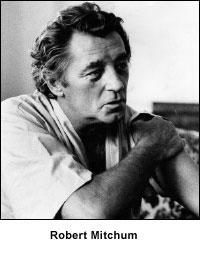
I’ve certainly waxed eloquent about Big Ol’ Robert Mitchum on more than one occasion: Mr. World Weary, sometimes a lug, often a thug, an unforgettable mug, sleepy-eyed and perpetually laconic, barrel-chested, with a voice emanating from some cavernous depth of his soul, a heart polluted by irony and a head filled with the simplest of desires--to be left alone, daddy. The newly released The Friends of Eddie Coyle (1973) has long resounded as one of Mitchum’s finest, despite and because of the fact that he’s in his later stage, more lumpen, decidedly slower, unsettlingly vulnerable, an aging but still wily lion in a jungle that’s become overtly desaturated.
Despite the unarguable fact that Mitchum as Coyle was indeed a both brilliant stroke of casting and a stirring and remarkably unselfconscious execution of a role, the movie has a bit more going for it. Brit director Peter Yates (Bullit, Breaking Away), possibly infected by temporary wisdom that many practioners of 70’s American cinema seemed to have collectively drawn upon, crafts a crime movie that simultaneously impacts as bonafide (and effecting) character study and a sideways exploration of the slow deterioration of the codes of masculinity. Yates, virtually working on the pinpoint level of a Robert Altman or a Hal Ashby, doesn’t flaunt a plot point, underline the action, or even zigzag around the merry-go-round. The movie just unfolds, a series of modulated interactions, predominately set in parking lots, way stations, coffee shops, dive bars, suburban enclaves, trailers, neighborhood banks, with nary a hitch in its everyday rhythms.
Of course, author George V. Higgins central conceit was that Eddie Coyle, third-string criminal, was nothing but a working stiff, albeit one with a slowly eroding set of codes, a simple guy with a simple desire-middle class survival. Yates, appropriating another 70’s transmutable element, just lets the movie unwind with no particular emphasis on any of the connective tissue, one way or another, regular citizen, low level law enforcer, big thief , little thief, those times they were a-changing, and your sinkhole is just, well, my sinkhole.
Mitchum lumbers gracefully through it all, a splintered square peg who can’t even find a round hole, a club fighter gasping through the later rounds, a tug boat slowing tearing away from its moorings. He’s bad, he’s sad; he’s a sap without poetry or flair, filled with old school doggedness and a philosophy borne out of inner city tenement origins. Yates surrounds him with some terrific players of the period, each one adding a dash of muted color—Richard Jordan as the curdled justice agent, Steven Keats as the hepped-up gunrunner, Alex Rocco as the blue collar heist man, and the impeccably inscrutable Peter Boyle as the low level bartender/informant that plays them all.
Tuesday, July 14, 2009
Big Tears

We all have our weaknesses, right? Mostly hidden, under-the-skin, behind-the-shades, no tickee, no talkie. I’m a self styled macho man, belying sensitivity, eschewing any and all qualities that might hint at the feminine, always stomping the ground in the No Tear Zone. What is it then about The Velvet Underground and Lou Reed’s early songwriting efforts at straightforward pop balladry, that just slices, dices, and wipes me out? When young/ambitious/Lou goes all poetic and maudlin, minor keys and strummy-strum, I just about break out in sobs and wanna run backwards into my childhood bedroom closet, hold onto my knees, scrunch my eyes closed, and rock slowly back and forth in forthright, contemplative solitude like some knee-socked, flaxen-haired, mixed-up shook-up, pre-flower child adolescent girl. Help me Rhonda, why does early/sincere/Lou elicit in my innards such a worrisome response? I dunno, I can’t explain, I’m simply not tuned in enough to my inner self (or outer idiocy) to even think about plunging somehow inward for those deep psychological reveals. I’m all surface baby, and digging it out there. Let me just roll out the handkerchief and bite manlike into a cigar and listen to Nico and Lou do the eternally killer Femme Fatale, or secret weapon Alejandro Escevedo do a to-die-for cover the Velvet’s Pale Blue Eyes with a goddam string quartet, or maybe trot out the ever sublime Sunday Morning. Somebody hide the absinthe from me, please.
Friday, July 10, 2009
DAILY INCONVENIENCE (REDUX)

Remember that oh-so-friendly term “convenience store”, meaning the corner milk store, the corner drug store, the Ma and Pa joint down the street from your house where you bought your daily newspaper or a pack of smokes? Well, it’s so far from convenient now that those same places are making headaches achier and ulcers ulcier and tempers not-so-tempered. The first part of my daily routine is almost monk-like in its serene simplicity. I leave my house, typically somewhere between 6:00 and 6:30AM, get gas if needed, grab a coffee, and head to the once-upon-a-time-convenience store in order to purchase 2 newspapers and a much needed ten-pack of cigars.That's That. Should take all of a minute and a half, two minutes tops, right? No way jack. Invariably, inevitably, somehow, all-the-time, EVERYGODDAMNDAY, the people in line if front of me seem to be there for one reason: TO SLOW MY DAY DOWN. Are any of these, my fellow life-sucking consumers, in a hurry to do anything or go anywhere? Do they love the vibe of 7-11 or Quik-Mart, or Brooks, or Ma and Pa Land? Do they love the décor, the ambience, the mostly zombie-like employees who both hate their job and their customers?
These time-killers appear as a few distinct types. There is the Senior Citizen A, the type that must, under all circumstances, reach slowly for their hidden away cash, and count out EACH AND EVERY dollar, dime, and penny, making society a better place by always paying with exact change. There is Senior Citizen B, who has learned the first name of the clerk, his or her family situation, whether they route for the Yanks or the Sox, and engages them in full discourse, at great length and detail, about the possibility of rain or sunshine EVERY SINGLE DAY. There is The Great Discounter A, armed with a mountain of clipped coupons, bent and determined to enhance their lives by saving 34 cents a day, even more determined to argue the validity of each coupon till death or savings, whichever comes first. There is The Great Discounter B, with a shopping cart as weapon, filled to the brim with multiple purchases of toilet paper and dish soap, buying bulk to fulfill their dreams and keep their basement shelves stocked with the true necessities of life. Finally, there is my fave, The Gambler, grubby fingers clutching scratch cards and lottery slips, knowing way deep down inside that they’re gonna hit the big one, ever ready and diligent to make the new purchase of that one-way ticket to the American Dream, taking their time at the register for good reason—the choice between a baseball scratch card and the tic-tac-toe one could very well be the diff between dust and gold.
I used to tell my pals that went I finally decided to let the years of accumulated rage kick in I was going to scale the roof of Providence’s Hot Club like a monkey on meth and set up for a sniping spree that would truly jumpstart a Friday night. Changed my mind. Man, when I finally flip my lid, I've decided to don some proper apparel (neat photo op, after all--plus I want my mother to see me in my best light when the tabloids run the story--haveta sport at leastone of my cooler-than-cool shirts), hook myself up with some bows and arrows, stamp them with a clear image of a ticking clock, sprinkle ‘em with gas or paint thinner, torch ‘em up, and stand atop the hood my car in the corner of the CVS on Reservoir Ave in Cranston, RI and pick off every single shopper who goes in or out before 7:00 AM on a random Tuesday or Wednesday, all the while giggling hysterically like Frank Gorshin-on-acid, hypnotically watching the flames leap from the fleeing bodies onto coupon inserts, neat little piles of scratch tics and big bundles of toilet paper. That ought to send a message, right?
Wednesday, July 8, 2009
Black and White and All Over

There is a piece in the newest Newsweek that shines a light on the dirty practice of rereading (dirty, rotten and tawdry because there is always so much new material begging to be read, and yup, it's a sin not be reading it), revisiting books read once, or even twice, for the easy pleasures of re-enlightenment, confirmation of greatness, or the simple scraping up of the bits and pieces that remain ensconced in daydreams and random back thoughts. Film Noir is a lot like that, the movie genre that isn’t really a genre, movies ill-defined and roughly grouped together because of shared tones, similar themes, certain visual characteristics, and a variety of filmic elements that make this movie pure noir to me and that movie all about noir to you. Like much Hollywood studio product, film noir efforts almost demand repeated viewings—the better to detail the corrosive themes, the atypically descending story arcs, the expressionistic cinematography, the puzzling feel of hypnotic hopelessness that surges through noirs, both minor and major. Thanks to a recent noir gifting from my California-based pallie Mattman, I’ve once again found myself prowling along darkened alleys and ever wet streets, visiting ill-lit docks and crummy second floor office spaces, essentially withdrawing from the healing powers of the sun while twisting my soul in encounters with hardboiled professionals, doppelgangers, femme fatales, and, again and again, world weary saps and suckers. Yeah brother, I’ve spent the last week being black and white all over.
Cry Danger (1951). Dick Powell as Rocky, just out of a five year stint for which he was framed, back to L.A. with revenge and detection in mind, archetypical tight-lipped, hardboiled, grimly determined and thoroughly obsessive. Director Robert Parrish eschews much of the typical nighttime lighting and a large portion of the story unfolds during the day, but it all occurs under a languorous California daytime sky, under which just about everybody in sight is a liar, a con, a betrayer, all of them uncovered in a mere 79 minutes as the extremely deadpan Powell rights his particular wrong in one itty bitty corner of a mouse-trapped world.
Alias Nick Beal (1949). John (father of Mia) Farrow was yet another middle-of-the-road, journeymen type, but as it occurred so often, his abilities arched a little higher while shooting a noir. This is indeed a strange entry, a supernatural noir, with Ray Milland at his crackling, dapper best as the devil-- first tempting and then curdling man-of-the-people politician Thomas Mitchell, and Audrey Trotter as a particularly hard-edged prostitute. The last second, kinda/sorta, positive finale doesn’t come close to erasing the corpulent scent that preceded it.
Wicked Woman (1953). Wop-bop-a-loom-bam, a first time viewing for me, at it knocked me right back. As raw and unfettered as Detour, with Beverly Michaels (writer/director Russell Rouse’s then wife), a platinum blond Amazon who is equal parts repellant and sexy-scary, planting her long legs, two outfits, and totally crooked smile in front of every guy-in-sight’s peepers, reducing the thick-necked and hard-rocked Richard Egan into a strikingly limp noodle. Another sundrenched noir, but hard as rain and sharp as a rusty nail, with only a half dozen settings and slathered with a sticky resonance akin to a just emptied shot glass. So very bad, and also awful (call it The Detour Factor), that it it’s really good, best illustrated by stock character guy, the short. rotund and perennially squeaky Percy Helton’s joyful descent into the dark side, so cool and disturbing that David Lynch probably rewatches this one when he’s eating his Sunday breakfast.
Angel Face (1953). Robert Mitchum was just about carved out for noir—the perpetual guy out of the past, the big dog that winds up kicked around like a sick puppy, the sad-eyed figure of the working class; who in noir (or anywhere else) ever accepted his bleak fate more manfully resigned and than Big Bob? Mitchum seemed readymade for the existential reality of post-World War II America; he in fact stood strong as a wordless cinematic poet in the precipitous slide into nothingness. (That's a mouthful, but really, no kidding.) With the masterful Otto Preminger etching the dark touches of fevered melodrama onto the proceedings, and the otherworldly loveliness of Jean Simmons as psychopathic temptress, this one almost climbs the haunting heights of the Preminger’s true noir classic, Laura. It’s that close, man.
Criss Cross (1949). Burt Lancaster, as another beautifully macho lost noir soul awash in the wiles of a predatory femme fatale (Yvonne DeCarlo) and the inescapable grips of his own fatalism. It’s a drab world, punctuated only be DeCarlo’s overwhelming sexuality, bursts of violence, and the ripening odor of ill-gotten gains. Robert Rossen (Body and Soul), ably abetted by a near perfect Milkos Rozsa score, frames Lancaster (and the other attendant dark shadows), despite or because of his inherent brute force, as yet another through-the-glass-darkly noir sucker, plunging headfirst into a quagmire of futility. One, among many, of Lancaster voice-overs sings out another line in that long versed siren song of noirs: “From the start, it all went one way.” Baby, ain’t that the cold, hard truth.
(By the way, tip of the dapper hat to Karl Malden, one time steel worker, a stage vet who made the easy transition to movies despite/because of his one-of-a-kind schnoz, a major league supporting player with a true center of gravity, a character guy who could ham it up and grind it down, and one of the few actual actors who made it into The Marlon Brando Respect Club.)
Subscribe to:
Posts (Atom)